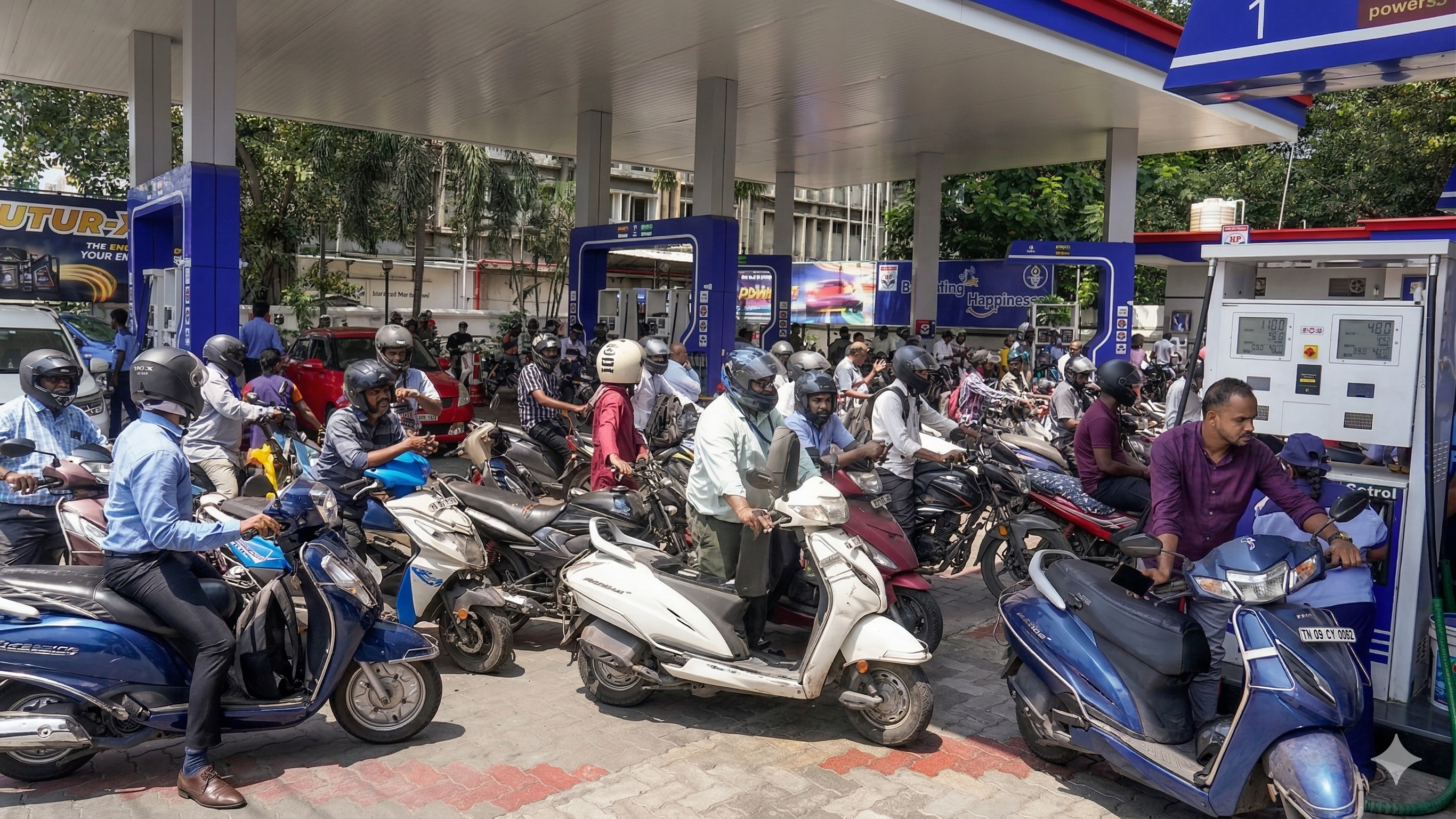
It began like any other evening. A few vehicles lined up at petrol pumps, nothing unusual for a country where fuel stations see steady traffic every day. But within hours, those ordinary queues turned into long, winding lines stretching onto the roads. Tempers rose, engines idled, and in many places, boards reading “No Stock” suddenly appeared.
Across cities like Chennai, Ahmedabad, Hyderabad and Surat, the same scene unfolded. People waited for hours, some growing anxious, others confused. The question echoed everywhere. What exactly caused this sudden rush, and why were petrol pumps shutting down so quickly?
The answer lies not in a nationwide fuel shortage, but in something far more powerful. Perception.
Over the past few days, messages began circulating rapidly on social media. They spoke of possible fuel shortages, rising tensions in West Asia, and fears that oil supply routes could be disrupted. For a country like India, which imports nearly 85 to 90 percent of its crude oil, such claims struck a nerve.
What followed was a familiar human reaction. People decided not to wait. Many rushed to fill their tanks, not because they needed fuel immediately, but because they feared they might not get it later.
As more people joined the queues, the sight of growing crowds reinforced the fear. Passersby assumed something was wrong and joined in. Within a short span, a routine refueling stop turned into a crowded hotspot.
This is how panic quietly builds. It does not begin with chaos. It begins with uncertainty.
Petrol pumps, however, are not designed for sudden surges of this scale. Most stations operate with limited storage, typically enough to meet regular demand for a couple of days. When hundreds of extra vehicles arrive within hours, that balance breaks. Fuel runs out faster than it can be replenished.
Tankers that supply petrol and diesel follow fixed schedules. They cannot instantly respond to unexpected spikes. As a result, pumps temporarily run dry, forcing operators to halt sales until the next delivery arrives.
What people then see is a closed pump, which only deepens the sense of shortage.
Authorities and oil companies have repeatedly clarified that there is no nationwide crisis. India maintains sufficient reserves, enough to sustain demand for several weeks. The supply chain continues to function normally. The disruption seen in various cities is local and temporary, driven largely by sudden demand rather than actual scarcity.
Yet for the common citizen, the experience feels very real. Hours are lost in queues. Daily wage earners and drivers see their income slip away. Vehicles burn fuel while waiting, adding to both cost and frustration. In some cases, fear has even led people to store fuel in unsafe ways, increasing the risk of accidents.
The pattern is not new. Similar situations have occurred before, during rumors of price hikes or supply disruptions. Each time, the cycle repeats itself. A spark of uncertainty leads to a rush, the rush creates temporary shortages, and those shortages validate the original fear.
Eventually, as official clarifications reach the public and supply stabilizes, the crowds begin to fade. Pumps reopen, queues shorten, and normalcy returns.
What remains is a reminder of how quickly perception can shape reality. In an age where information travels instantly, even unverified claims can influence behavior on a massive scale.
The recent rush at petrol pumps was not a story of fuel running out. It was a story of how fear, amplified by rapid communication, can momentarily disrupt an otherwise stable system.
For now, officials continue to urge citizens to follow their regular refueling habits and rely on verified information. Because sometimes, the biggest shortage is not of fuel, but of certainty.