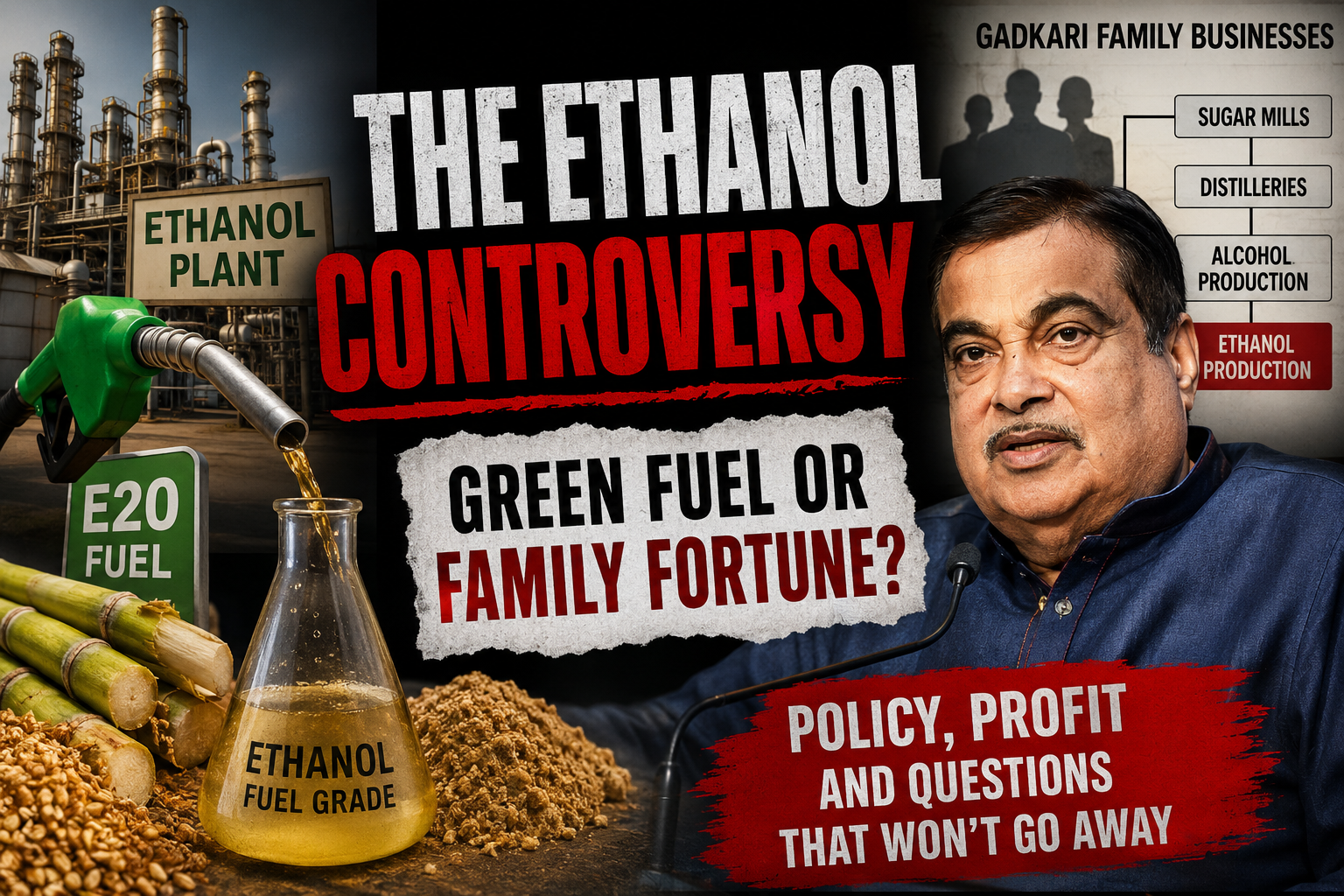
For millions of Indians filling up their vehicles today, ethanol-blended petrol has become the new normal. What began as a policy to reduce crude oil imports has evolved into one of India’s largest energy transitions, backed by ambitious government targets, billions of rupees in investment, and a nationwide push toward flex-fuel vehicles.
But alongside the government’s vision of cleaner energy and energy security, another debate has steadily gathered momentum. Recent public discussions have brought renewed attention to an aspect that many ordinary citizens may not have been aware of: members of Union Road Transport and Highways Minister Nitin Gadkari’s family have long-standing business interests in sugar, distillery, and ethanol manufacturing.
The discussion intensified after Gadkari himself spoke openly in a recent podcast about his family’s agro-industrial businesses, including distillery operations. While he has repeatedly maintained that he no longer manages these companies, critics argue that the overlap between public policy and private industry deserves greater public scrutiny.
India’s Ethanol Mission
India’s Ethanol Blending Programme was introduced with multiple objectives: reduce dependence on imported crude oil, support farmers by creating an additional market for agricultural produce, improve energy security, and lower vehicular emissions.
Today, petrol sold across much of the country contains up to 20% ethanol, with the government encouraging automobile manufacturers to produce flex-fuel vehicles capable of operating on higher ethanol blends in the future.
Government data indicates that increased ethanol blending has helped reduce crude oil imports and channel substantial payments to domestic farmers and ethanol producers.
The Business Behind Biofuel
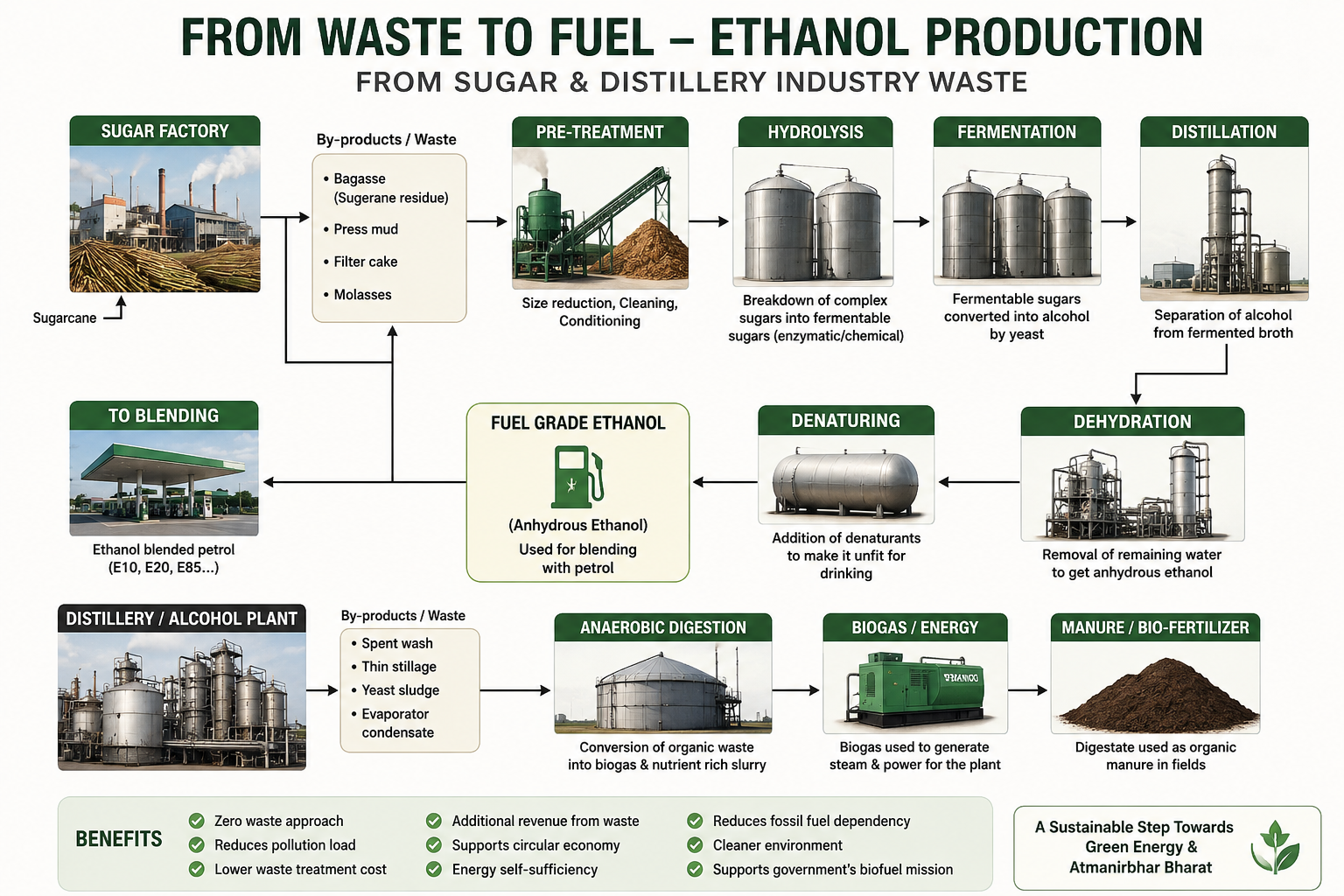
Ethanol is produced by fermenting plant sugars and starches before undergoing distillation and dehydration to produce fuel-grade alcohol. It can be manufactured from sugarcane, molasses, maize, damaged food grains, and agricultural residues.
Less widely known is that modern breweries and distilleries can also recover ethanol from certain waste streams generated during alcohol production. Waste beer, rejected batches, fermentation residues, and some by-products can be processed into fuel-grade ethanol instead of being discarded. Advanced second-generation technologies can also convert fibrous residues such as brewery spent grain into bioethanol, although this requires additional processing.
Many integrated sugar and distillery complexes around the world pursue “zero-waste” manufacturing, where multiple by-products are reused to generate additional revenue streams, including electricity, compressed biogas, cattle feed, and ethanol.
Why Zero-Waste Matters
Industry experts say waste management represents a significant operating cost for large distilleries.
Instead of treating certain by-products purely as waste, companies increasingly seek to extract additional value from them. Some by-products are sold as cattle feed, while others may be processed further into commercially valuable products where technically and economically feasible.
For integrated sugar-distillery complexes, this approach can improve overall efficiency and reduce disposal costs.
Critics argue that such integrated business models become even more profitable as government demand for fuel ethanol increases.
However, experts also note that brewery waste alone represents only a small fraction of India’s total ethanol requirement and cannot independently supply a nationwide blending programme.
The Gadkari Family’s Industrial Interests
Public corporate records show that businesses associated with members of the Gadkari family have interests spanning sugar processing, distillery operations, ethanol production, and related agro-industries.
The minister has acknowledged his family’s historical involvement in this sector while stating that he resigned from corporate management years ago and does not participate in day-to-day business decisions.
His supporters argue that these businesses existed well before the rapid expansion of the Ethanol Blending Programme and represent only a small share of India’s overall ethanol production.
Questions Raised by Critics
The controversy centres not on whether ethanol should be promoted, but on whether sufficient safeguards exist when senior policymakers publicly advocate policies that may also benefit industries connected to close family members.
Critics ask whether expanding ethanol mandates, promoting flex-fuel vehicles, and encouraging greater ethanol consumption could indirectly increase demand for products manufactured by companies operating in this sector.
Some transparency advocates have called for clearer disclosure mechanisms to help maintain public confidence in policymaking.
Taxation Debate
Another issue occasionally raised in public discussions concerns the different tax treatment of beverage alcohol and fuel ethanol.
Potable alcohol intended for human consumption is subject to a different taxation and regulatory framework than denatured fuel ethanol, which is produced for industrial or automotive use and cannot legally be consumed as a beverage. These are governed under separate legal and taxation regimes.
Some commentators have questioned whether integrated distillery businesses could gain commercial advantages by expanding fuel ethanol production alongside traditional alcohol manufacturing. However, there is no public evidence or official finding that businesses associated with the Gadkari family have improperly classified alcohol, misused ethanol incentives, or avoided taxes through ethanol production. Such claims remain speculative without documentary proof or findings from competent authorities.
The Minister’s Position
Nitin Gadkari has consistently defended India’s ethanol policy as a national economic strategy rather than a business initiative.
He argues that higher ethanol blending reduces India’s dependence on imported crude oil, strengthens energy security, supports farmers, and promotes cleaner transportation.
He has also maintained that he has no operational involvement in his family’s companies and rejects suggestions that government policy has been framed to benefit private business interests.
A Debate That Will Continue
India’s ethanol programme remains one of the country’s most significant energy reforms, but it has also become a case study in how major public policies can invite scrutiny when they intersect with private commercial interests.
For supporters, ethanol represents a pathway toward energy independence, rural development, and lower emissions.
For critics, it raises broader questions about transparency, governance, and the importance of ensuring that public policy is not only fair but also seen to be free from potential conflicts of interest.
As India continues expanding its biofuel ambitions, those questions are likely to remain part of the national conversation.