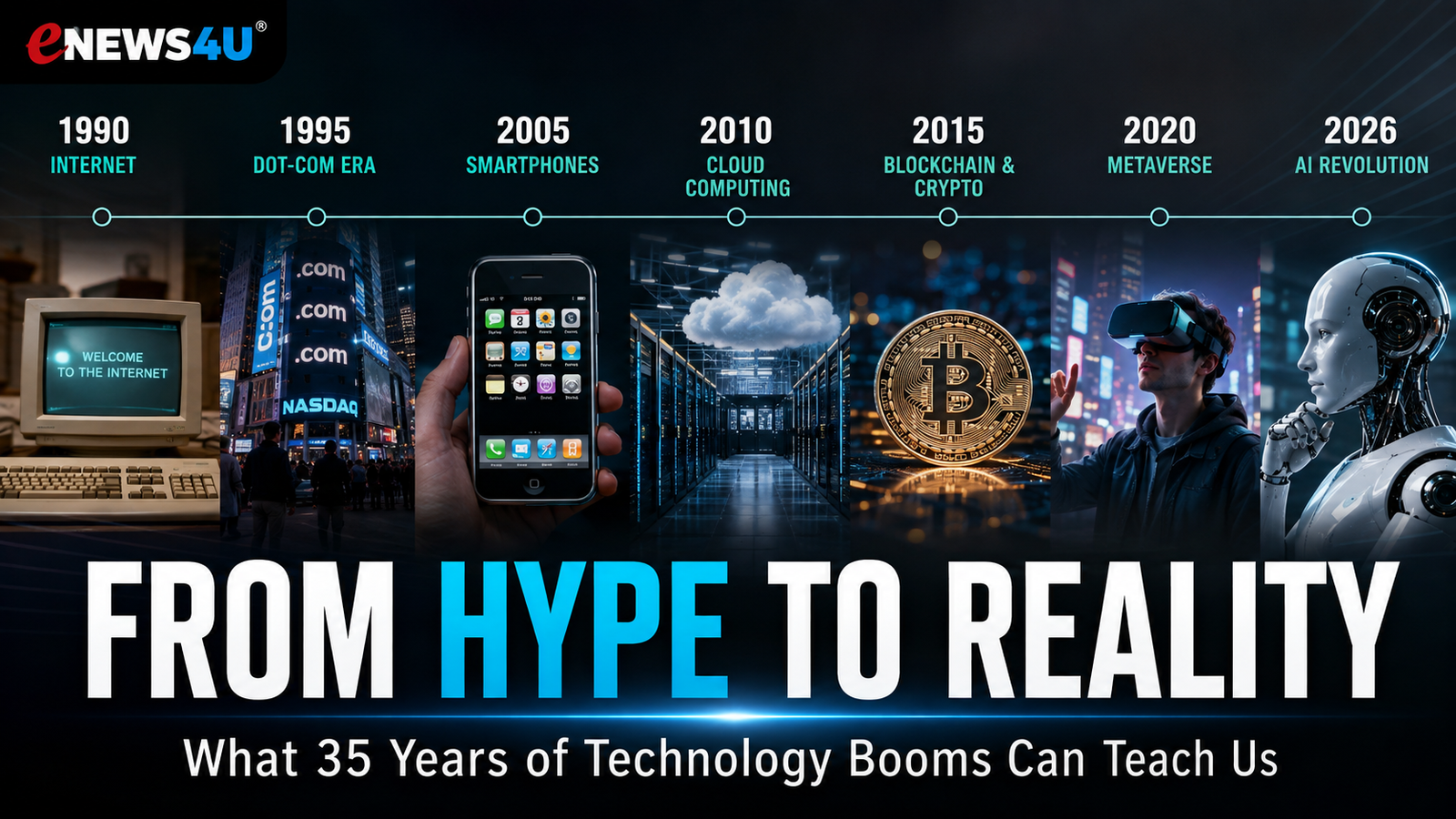
From “the Internet will change everything” to “AI will change everything”
Every generation of technology arrives with a promise.
In the 1990s, it was the Internet. In the 2000s, it was Web 2.0 and mobile computing. In the 2010s, cloud computing, big data, the Internet of Things, and blockchain competed for attention. During the pandemic years, the metaverse and Web3 briefly dominated the conversation. Since late 2022, artificial intelligence has taken centre stage.
The technologies are different, but the pattern is remarkably familiar:
Innovation → Excitement → Investment → Exaggerated Expectations → Disillusionment → Consolidation → Practical Adoption
This is broadly consistent with Gartner’s Hype Cycle framework, which describes emerging technologies moving from an innovation trigger to inflated expectations, disillusionment, more realistic experimentation, and eventually productive use.
The crucial lesson from the past 35 years is that a technology can be genuinely transformative and still be surrounded by an investment bubble.
The Internet survived the dot-com crash. Cloud computing survived years of skepticism. Smartphones became everyday infrastructure after being heavily hyped. Blockchain lost much of its glamour but did not disappear. And today’s AI boom is now entering the stage where investors, companies, and governments are beginning to ask a harder question:
“How much economic value will all this technology actually create?”
Overview: 36 Years of Tech Hype
| Period | Technology | Hype Level | What Happened Next |
|---|---|---|---|
| 1990–1994 | Internet | High | Became the foundation of the digital economy |
| 1995–1999 | Web & e-commerce | Extreme | Dot-com bubble burst, but Internet adoption continued |
| 2000–2005 | Web 2.0 | Rising | Social platforms and user-generated content emerged |
| 2005–2010 | Smartphones & mobile | Extreme | Became a dominant computing platform |
| 2008–2015 | Cloud computing | High | Became core enterprise infrastructure |
| 2012–2016 | Big Data | High | Useful, but many predictions were exaggerated |
| 2014–2018 | Internet of Things | High | Strong industrial applications; weaker consumer revolution |
| 2016–2022 | Blockchain & crypto | Extreme | Speculative boom followed by major correction |
| 2019–2022 | 5G | High | Important network upgrade, but less revolutionary than advertised |
| 2020–2022 | Metaverse | Extreme | Interest collapsed after expectations raced ahead of adoption |
| 2021–2022 | NFTs/Web3 | Extreme | Speculative market crashed; selected infrastructure remained |
| 2022–2026 | Generative AI | Extreme | Rapid adoption and investment; economic impact still unfolding |
| 2025–2026 | AI agents & autonomous systems | Very high | Moving from experimentation toward real business deployment |
This table reveals an important distinction: hype is not the same thing as technological success.
1. The Internet: A Bubble Built Around a Real Revolution
The Internet may be the clearest historical example of how a technology can be simultaneously overhyped and underestimated.
During the second half of the 1990s, investors poured money into Internet companies. Businesses with little revenue could command extraordinary valuations simply by attaching .com to their names. The Nasdaq Composite rose dramatically during the late 1990s before reaching a peak of roughly 5,048 in March 2000, plunging sharply as the dot-com bubble burst.
But something remarkable happened: The companies disappeared; the Internet did not.
The bubble had confused two separate propositions:
- Proposition 1: The Internet will fundamentally change the economy.
- Proposition 2: Almost every company associated with the Internet will become enormously valuable.
The first turned out to be largely correct. The second was spectacularly wrong. This distinction is essential when looking at today’s AI market.
2. Web 2.0: When the Internet Became a Platform
After the dot-com crash, technology investors became more cautious, but the underlying infrastructure continued improving. Broadband expanded. Search engines became more powerful. Online advertising matured. Social networks emerged, and user-generated content became a major part of the web.
This period produced companies and business models that eventually became far more economically significant than many of the speculative dot-com ventures of the 1990s. The Internet had entered a new phase:
Technology Story → Infrastructure → Everyday Utility
3. Smartphones: Hype That Largely Came True
The smartphone revolution created enormous expectations during the late 2000s and early 2010s. The core prediction was simple:
“The computer in your pocket will become the primary interface to the digital world.”
Unlike many technology predictions, this one turned out to be remarkably close to reality. Smartphones changed communication, photography, banking, shopping, transportation, entertainment, advertising, and social interaction.
The hype eventually disappeared because the technology became ordinary. When a technology succeeds, it often stops looking like a headline story. Nobody wakes up in 2026 saying, “The smartphone revolution is amazing.” People simply use smartphones.
4. Cloud Computing: From Controversial Idea to Invisible Infrastructure
Cloud computing followed a similar trajectory. At first, companies questioned whether businesses would trust critical workloads to external infrastructure. Over time, the economics became difficult to ignore.
Cloud computing allowed companies to rent computing resources rather than build and maintain all infrastructure themselves. It enabled faster software development, global deployment, and scalable services.
Gartner continues to track cloud technologies as an evolving ecosystem in 2025, with AI increasingly becoming an important driver of next-generation cloud capabilities. The lesson is subtle: successful technologies often disappear into the infrastructure layer.
5. Big Data and IoT: Useful Technologies, Exaggerated Narratives
The 2010s produced another wave of technology slogans: “Data is the new oil,” “Everything will be connected,” and “The Internet of Things will connect billions of devices.”
There was real substance behind these claims. Companies accumulated enormous quantities of data, sensors became cheaper, industrial equipment became connected, and cars became computerized.
However, the most spectacular predictions did not necessarily happen. Not every refrigerator needed to become an Internet platform, and not every business gained enormous value simply because it collected more data. A technology can be deeply useful without fulfilling its most dramatic promises.
6. Blockchain: When Hype Became Speculation
Blockchain represents one of the strongest examples of technology hype in the 2010–2022 period. The original proposition was powerful: create digital systems in which participants can coordinate and transfer value without relying entirely on a central authority.
The narrative expanded to position blockchain as a potential replacement for banks, payment systems, supply chains, databases, identity systems, and entertainment.
Investment followed the narrative. Blockchain and cryptocurrency startups attracted billions of dollars in venture funding during the 2021–22 boom. CB Insights reported record blockchain investment during 2021 and continued infrastructure investment even as the market declined.
Then came the crash. Cryptocurrency prices fell, NFT trading collapsed, numerous companies failed, and investor enthusiasm waned.
Yet, blockchain did not vanish. Infrastructure development continued while speculative applications lost attention. The industry moved from “Blockchain will change everything” to “Which specific applications actually make economic sense?”
7. The Metaverse: When Marketing Outran Technology
During 2021 and 2022, the metaverse concept promised persistent virtual worlds, virtual offices, digital property, and avatars replacing traditional online interfaces.
Mass adoption did not arrive at the speed implied by the hype. The result followed a familiar trajectory:
Attention Declined → Investment Selective → Strategy Shifted → Narrative Faded
The underlying technologies—virtual reality, augmented reality, 3D graphics, and spatial computing—did not disappear. The grand prediction simply failed to arrive on schedule.
8. Generative AI Takes the Stage
ChatGPT’s public release in late 2022 created a new technology cycle. Generative AI moved swiftly from a specialist research subject to mainstream business software across search, programming, customer service, marketing, healthcare, and enterprise workflows.
By 2025, the conversation was already changing. Gartner’s 2025 AI Hype Cycle noted that while AI investment remained strong, attention was shifting from initial generative-AI excitement toward foundational enablers such as AI-ready data, AI agents, AI engineering, and ModelOps.
Gartner identified AI agents and AI-ready data among the fastest-advancing technologies on its Hype Cycle, while noting both were experiencing heightened interest and ambitious expectations.
It is the same transition seen repeatedly in previous technology cycles:
“Look what this technology can do!” → “How do we make money from it?”
9. 2026: The Reality-Check Phase
By 2026, the AI story is no longer simply about chatbots. The industry is focused on AI agents, autonomous systems, specialized models, and deep enterprise process integration.
Gartner’s emerging-technology research identified AI agents, decision intelligence, and autonomous operations among technologies supporting what it calls an emerging “autonomous business” era.
At the same time, market concerns have become visible. Recent analysis compares today’s massive AI infrastructure spending with previous investment cycles, including the dot-com era. Analysts argue that infrastructure spending could become excessive if monetization fails to keep pace.
The technology is real; the ongoing question is whether current expectations and valuations are realistic.
Key Takeaways: Lessons From 1990–2026
Looking at 36 years of technology history reveals something counterintuitive: the biggest technology winners were not necessarily the technologies with the biggest hype.
Technology Success ≠ Investment Success
Technology Failure ≠ Hype Failure
Why Does Technology Hype Keep Repeating?
- Investors extrapolate too quickly: Early 10x growth is assumed to continue linearly, ignoring scaling friction.
- Media rewards dramatic predictions: Extreme claims generate far more engagement than modest efficiency stats.
- Companies need a growth story: Narratives attract critical venture capital, market share, and technical talent.
- Early demos hide integration costs: Working in a lab is far simpler than deploying reliably at enterprise scale.
- Markets price the future: Valuations reflect optimistic long-term possibilities rather than immediate cash flows.
“The hype usually dies; the useful technology often doesn’t.”
What Happens Next for AI?
| Scenario | Path Forward | Historical Parallel |
|---|---|---|
| Scenario 1 | The Internet Scenario: AI is genuinely transformative, but current valuations prove unsustainable. The bubble deflates; the technology continues. | Dot-Com Era (2000–2003) |
| Scenario 2 | The Blockchain Scenario: AI remains useful but achieves narrower economic transformation than forecasted. A smaller set of specialized applications survive. | Crypto / Web3 Shift (2022–2024) |
| Scenario 3 | Foundational Transformation: AI becomes an essential utility comparable to electricity or the Internet, reshaping global productivity. Today’s hype looks conservative. | Industrial / Digital Revolutions |
The Real Signal to Watch
Instead of asking, “Is AI overhyped?” the better question is:
“Is productivity growing fast enough to justify the investment?”
Key Metrics Defining the Next Phase:
- Enterprise AI revenue and monetization models
- Measurable productivity gains in corporate workflows
- Inference cost reductions and chip efficiency gains
- Data-centre utilization rates vs. built capacity
- Startup survival rates and capital efficiency
- Consumer willingness to pay for standalone AI services
From Hype to Boring Infrastructure
The greatest technologies eventually become boring.
The Internet became Wi-Fi. Cloud computing became the server room nobody sees. Mobile computing became the phone everyone carries. Electricity became a socket in the wall.
If AI succeeds at the scale its advocates predict, the final stage of the revolution will not look like an AI revolution at all-it will simply become another invisible layer of everyday life.