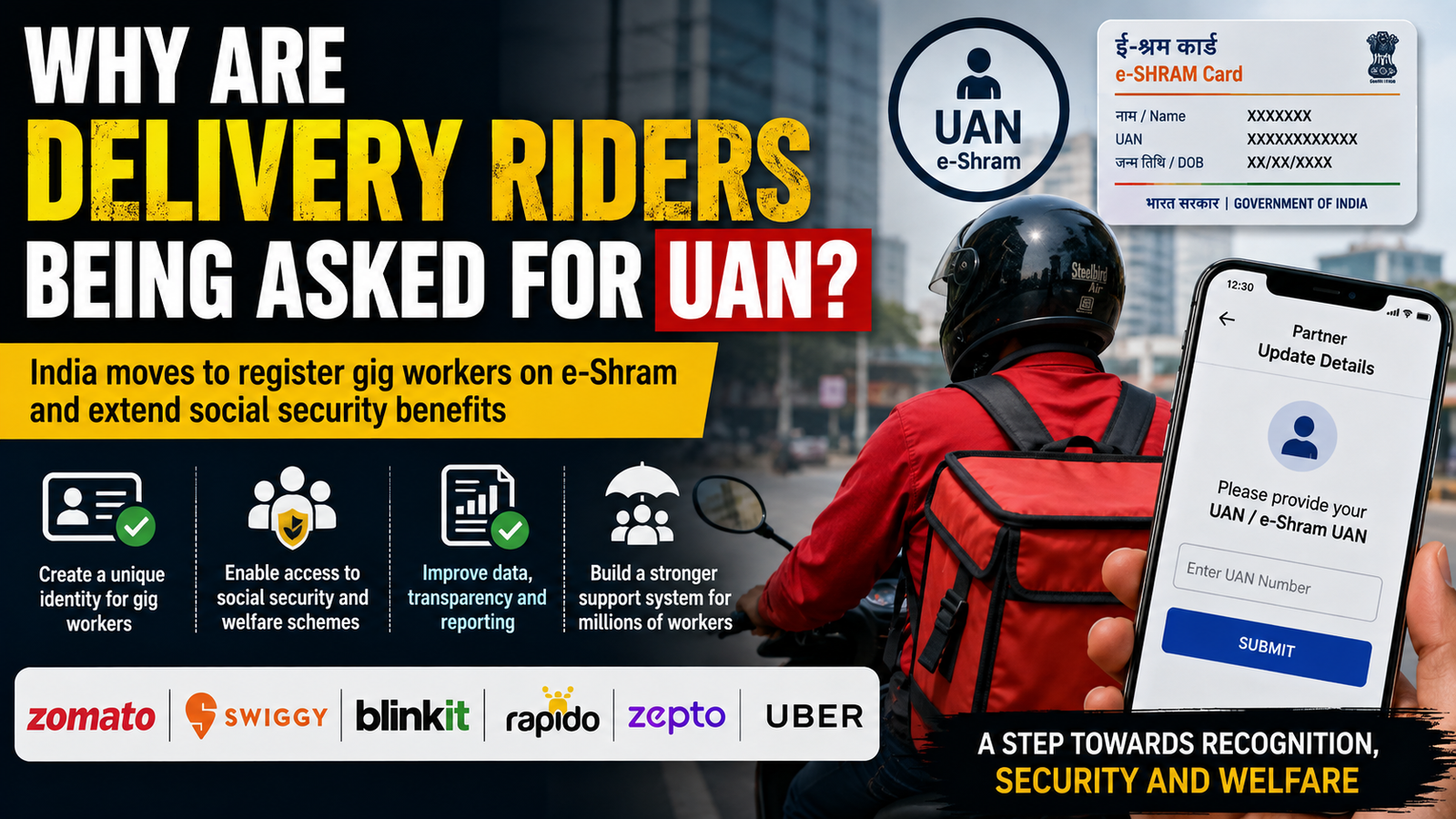
Food delivery, quick-commerce, ride-hailing and logistics platforms are increasingly asking delivery partners and other gig workers to provide their Universal Account Number, or UAN, as India moves to formalise the country’s rapidly expanding platform workforce.
The request has left many delivery riders wondering whether platforms are introducing provident fund deductions or changing their employment status. In most cases, however, the UAN being requested in this context is linked to e-Shram registration, not necessarily an Employees’ Provident Fund Organisation (EPFO) account.
Government Push Behind the UAN Requirement
The Ministry of Labour and Employment says the e-Shram portal registers unorganised workers, including gig and platform workers, and provides them with a Universal Account Number on a self-declaration basis.
The government launched an Aggregator Module on e-Shram in December 2024 to streamline the registration of aggregators and the platform workers engaged through them. By January 2026, the Labour Ministry said 12 major aggregators had been onboarded, including Zomato, Blinkit, Urban Company, Uber, Amazon, Ola, Swiggy, Rapido, Zepto and Porter.
Why Platforms Need the Number
The UAN gives the government a common identifier through which a gig worker can be recorded in the national database. For platforms, linking a rider’s profile with the worker’s government identifier can help establish a more structured record of the people working through their systems.
This becomes particularly important as the government moves toward implementing social-security provisions for gig and platform workers.
Gig Workers Now Recognised Under Social Security Law
The Code on Social Security, 2020 came into force on November 21, 2025 and formally introduced definitions for gig workers and platform workers. The framework provides for social-security measures covering areas such as life and disability protection, accident insurance, health and maternity benefits and old-age protection. It also provides for a Social Security Fund for such welfare schemes.
The government’s Budget 2025-26 measures also included registration of gig workers on e-Shram, issuance of identity cards and extension of healthcare benefits under Ayushman Bharat-Pradhan Mantri Jan Arogya Yojana.
Platforms Face Greater Reporting Responsibilities
The new framework is also increasing the reporting obligations of aggregators. Under the rules reported in May 2026, aggregators are required to upload details of gig workers engaged with them and record new appointments and exits. The rules also establish work-duration requirements for workers seeking certain social-security benefits.
Gig workers generally need at least 90 days of engagement with one aggregator in the relevant period, while the threshold rises to 120 days for workers engaged with multiple aggregators, according to the reported rules.
Does UAN Mean PF Will Be Deducted?
Not automatically.
An e-Shram UAN should not be confused with an EPFO UAN used for provident-fund accounts. The fact that a delivery platform asks a rider for a UAN does not by itself establish that the rider has become a conventional salaried employee or that PF deductions will begin.
The immediate purpose of the e-Shram UAN is to create and maintain a recognised identity for workers in the unorganised and platform economy and help connect eligible workers with government social-security programmes.
Why Riders Are Seeing the Request More Often
The increased requests are part of a wider transition from an informal gig economy toward a more structured system of worker identification, registration and social-security administration.
As more aggregators integrate their systems with e-Shram and government reporting requirements become operational, riders who previously worked without a formal government-linked worker record are increasingly being asked to provide or obtain their UAN.
What Delivery Partners Should Check
Riders should first determine which UAN the platform is asking for. If the request specifically refers to an e-Shram UAN, it relates to the government’s unorganised-worker database. If an application specifically asks for an EPFO UAN, the purpose is different.
Workers should also avoid sharing their UAN, Aadhaar or other identity information through unofficial links or messages. The safest approach is to complete registration or verification through the platform’s official application or the government’s authorised services.
India’s Gig Economy Enters a More Formal Phase
India’s gig economy is expanding rapidly, with the Labour Ministry citing a NITI Aayog estimate that the country’s gig and platform workforce could rise from 7.7 million in 2020-21 to 23.5 million by 2029-30.
The growing demand for UAN and e-Shram information is therefore not simply a platform-level documentation exercise. It is part of a broader effort to create a formal identity and social-security framework for millions of workers earning through digital platforms.
For delivery riders, the change could eventually mean better access to welfare and social-security programmes. For platforms, it means greater responsibility for maintaining accurate worker records and complying with the country’s evolving gig-worker regulations.